
Our objectives
CoolHeatDC is a three-year R&D project funded under the CETP 2024 Call geared at achieving the following main technical and non-technical objectives.
Technical aims

Sustainable working fluids
Evaluate natural working fluids as alternative to synthetic refrigerants for safe, efficient two-phase immersion cooling

Advanced testing & modeling
Develop tools and infrastructure for broad experimental and numerical investigation of two-phase immersion cooling systems

Integrated heat pump solution
Design, build and validate at lab level a heat pump directly integrated into two-phase immersion cooling for data centers
Non-technical aims

Market-driven requirements
Translate industrial needs into clear technical and operational specifications

Techno-economic evaluation
Access scaleability and feasibility in industrial settings and define priority follow-up on R&D actions

Stakeholder engagement
Enable early adoption of results through targeted strategic engagement and transparent communication
OUR RESEARCH APPROACH
The CoolHeatDC consortium has started to work on the project on 12/2025 thereby following a three-phased structured research approach.
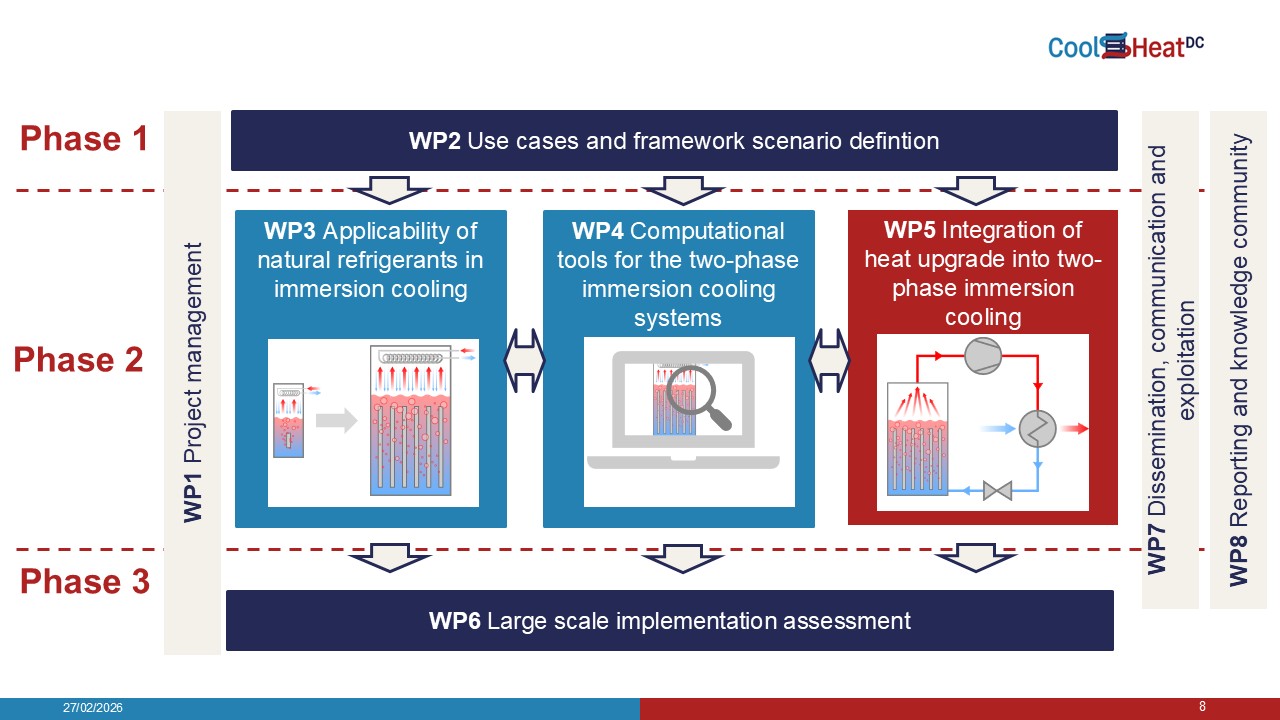
In Phase 1 we define a practice-oriented, market-driven research framework. Realistic use cases and key performance indicators are developed to steer the technology development in a targeted manner and to enable techno-economic evaluation.
Phase 2 focuses on the required technological innovations. This includes both experimental work at laboratory scale and simulation activities. By simultaneously investigating three different aspects—the assessment of natural working fluids, the development of advanced computational tools for optimization, and the direct integration of a heat pump—technological innovation is driven forward in parallel. This significantly increases efficiency in terms of both cost and time-to-market.
In Phase 3 we finally evaluate the practical applicability of the CoolHeatDC solution in large-scale data center operation and in further applications. We assess the technical and economic advantages of the new technology, investigate additional application possibilities, and derive the further R&D needs leading up to market deployment.